There was a time when conventional taxis were the talk of the town. You had to call the taxi operator, book a cab, and wait for the taxi to arrive. In the present era, people's patience level has dropped.
They now want instant gratification, which they can only get if they have more control over the booking process. This is where the gradual shift to app-based taxi booking systems has revolutionized the transportation business.
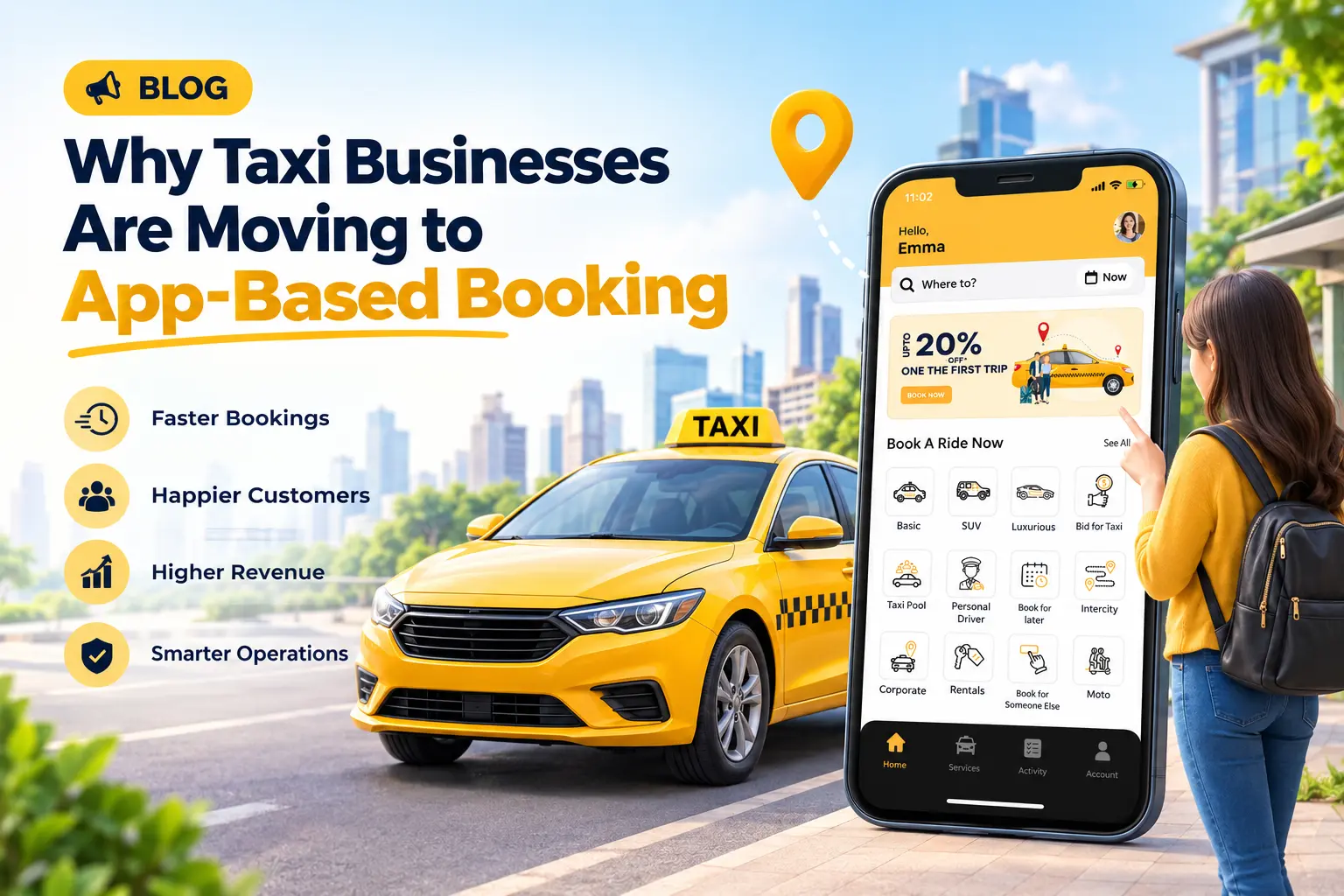
Today, taxi business technology has reached new heights. We are seeing online taxi booking taking their place. The biggest advantage of an online taxi booking system is that there is no need for a mediator. You can directly take advantage of an on-demand taxi app and book a cab by filling in the pick-up and drop-off locations.
This is just a small explanation of why taxi businesses are moving to app-based booking.
We will be discussing some other important points for you if you are an entrepreneur or business owner who wishes to get started with the latest taxi booking software and take your digital taxi booking services to the next level.
So, let us begin.
What Do Modern Riders Expect From a Contemporary Taxi Booking App?
In today’s world, where commuting from one place to another has become essential, having an app-based taxi booking service has become the need of the hour. However, this does not mean that the expectations of the riders have reduced. It has only grown with time.
Now riders do not merely accept the bare minimum; they want convenience but at a cost-effective price. Here is a list of things that have become non-negotiable when it comes to the expectations of a modern rider from a contemporary taxi booking app.
- A single-tap booking experience
- Real-time driver tracking on the map
- Transparent, upfront fare estimates
- Multiple ride categories
- Multiple payment options
- Option to schedule a ride
- In-App chat
- Ride history
- Push notifications
- Live trip sharing
- SOS/emergency buttons
- Women passenger and women-driver options
…and more
Now that we have listed the expectations of modern-day riders from a contemporary taxi booking app, it is time to divert our attention to the exact reasons that make taxi businesses move towards app-based booking.
Reasons for Taxi Businesses to Move towards App-Based Booking
The traditional taxi booking business has certain loopholes that can only be resolved if a modern-day app-based booking is executed. Let us look at them.
1. Long Waiting Times with No Estimation
The traditional taxi booking system had a major downside. Riders had to wait for the taxi to arrive with no estimate of the time taken. The reason for this was that everything was done in a traditional way.
Everything was said verbally with a rough time, and there was no way to accurately estimate the time it would take for the cab to arrive.
However, today, with the usage of app-based booking, riders can get the estimated time it will take a driver to reach the pickup location. This reduces the waiting time as they can relax at the pickup location while the cab arrives.
This gives the liberty to the rider to concentrate on other activities by the time the cab arrives at the pickup location.
2. Manual Way of Handling Ride Management
Traditionally, the taxi booking system did not had an automated process to link riders with the drivers that were available at the drop-off location. Also, the assignment used to take a long time due to the use of manual phone dispatch.
There were even times when they used to miss several bookings due to oral communication with the rider.
However, with the emergence of app-based booking systems, it has become easier to use taxi dispatch software and assign rides in milliseconds. The drivers can also use live GPS tracking so that they do not have to ask the rider about the drop-off location.
It also helps in managing digital payments. This way, you can manage the entire ride conveniently without any manual intervention.
3. No Price and Route Transparency
The traditional taxi booking system had a major problem where there was a chance of a price dispute once the ride was over. The route that the driver used to take was also manual.
This caused unnecessary delays and even disputes with the rider since they wanted the driver to take a different route. However, with the help of a digital taxi booking system, it has become easier for both the rider and the driver to check the route during the ride using an online platform.
The rider can even check the price before he/she books the taxi. This way, both the rider and the driver have complete information about the price and route before even getting into the cab.
4. Restricted Payment Option
Traditional taxi booking systems accept only one or two payment options such as cash and card. This made it tougher for the driver to get the payment once the ride ended. This was one of the biggest problems with the good-old taxi system.
With the modern-day app-based booking system, riders get multiple payment options such as cash, debit or credit cards, e-wallets, etc., to make payments. The riders can even use UPI to make hassle-free payments.
5. No Way to Give or Receive Feedback After the Ride Completion
In the traditional taxi booking setup, there was no way to give or receive feedback once the rider reached the drop-off location. The reason for this was that there was no online platform or app through which riders could rate the driver after completion of the journey.
Also, the driver did not have the opportunity to rate the rider. There was a two-way gap between the driver and rider. This particular issue was resolved with the help of an app-based booking system, as both riders and drivers could rate each other after completion of the journey.
This way, a potential rider could see the rating and then decide whether to accept the ride from the driver or not.
6. No In-App Communication
Traditional taxi booking systems did not provide a platform through which riders could send messages to the drivers once the booking was confirmed. There was no other way except for sharing personal information to communicate with each other.
Whereas the modern-day app-based booking system allows riders to send messages to the drivers after confirmation using its online platform. This way, riders can give standing instructions to the drivers, if any, before the ride.
7. Lack of Smart Route Optimization
The modern-day app-based booking system makes effective use of AI technology to suggest that drivers navigate through an alternate route if there is a lot of traffic in a particular area.
This technology was not even available earlier, and there are still taxi operators who lack optimized use of this smart route in today’s time.
8. No Way to Check the Driver Performance
With the use of AI, it becomes possible for app-based booking systems to keep a close watch over the driver's performance, such as their ratings, trip effectiveness, and service quality, which was not possible with the traditional taxi system.
Final Words
People accept taxi rides to commute from one place to another with a stellar riding experience. This is where app-based taxi booking helps establish a key step in raising their expectations.
If you wish to start a taxi business, start by affiliating with an established taxi booking app development company such as V3Cube. Their developers will help convert your raw business idea into a fully-fledged taxi booking app that sets the tone for your business.
FAQs
Q1. Why is customer retention considered to be an important thing for taxi apps?
A repeat customer signifies that they have liked your services. You can then target and convert them into a loyal customer base by encouraging them to visit the app on a regular basis.
Q2. Enumerate the role AI plays in taxi booking systems.
With the integration of AI in your modern-day taxi booking system, you can match rides with drivers, detect fraud early, estimate the growing demand so that drivers can charge a surplus, if needed, and customize the experience of your customers.
Q3. Which features do the modern-day riders expect from taxi apps?
Live trip sharing, integrating SOS/emergency buttons, women passenger and women-driver options, a single-tap booking experience, etc., are some of the features that modern-day riders expect from taxi apps.
Q4. Is it possible for modern-day taxi app systems to integrate maps, GPS, and payment gateways?
Indeed! Modern-day app systems integrate mapping and GPS services so that they can be used for map navigation and live tracking. They are also compatible with popular payment options such as cash, credit/debit cards, e-wallets, or other digital payment methods in a secure manner.