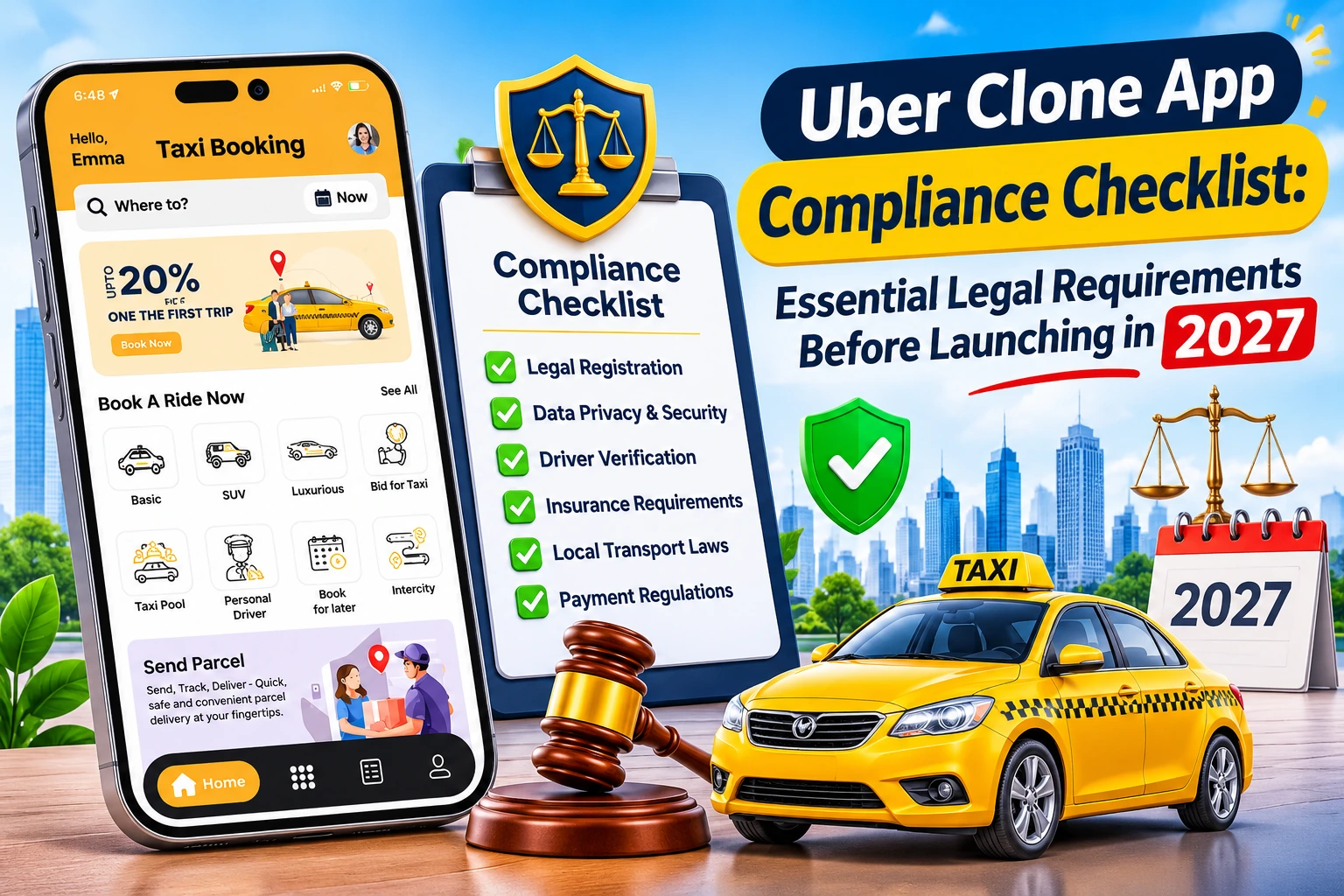
Starting an Uber-like ride-hailing business consists of more than just the app development and driver registration process. The taxi booking app development solution also includes aspects such as transportation licensing, driver verification, rider protection, insurance, and compliance with data protection laws and payment regulations. Each country, state, and city has its own unique requirements.
Hence, before entering the market in 2027, businesses need to be aware of their legal responsibilities concerning their operating model and target location. Here’s a checklist of the key compliance aspects to pay attention to before implementing a taxi booking platform.
Understand the Uber Clone Legal Requirements
The first task is determining the applicable law that would be necessary for the business’s operation. This could be a ride-hailing platform functioning as either a technology intermediary, a transport operator, a fleet manager, or a combination of the three, depending on the local legislation and on how services are structured.
The Uber Clone legal requirements may include:
- Company registration and relevant commercial licenses.
- Licenses for transportation and ride-hailing.
- Driver and vehicle requirements.
- Safety and insurance requirements for riders.
- Data and consumer protection laws.
- Taxation registration, reporting, and payment obligations.
Requirements should be checked with the appropriate transport authority, business regulator, and legal adviser at each operating location planned for the launch of the project. A valid license in one city does not guarantee a valid license in another city.
Review Uber Clone App Regulations for Drivers and Vehicles
Ride-hailing operations depend on drivers and vehicles. Before accepting ride requests, there should be a platform in place to ensure that both meet the local requirements.
Important checks include:
- Check driving licenses, ID cards, and professional permits.
- Ensure the necessary insurance will cover the commercial and rider usage of the vehicle.
- Implement a process for checking the expiration dates of the documents and updating the drivers' records.
Uber Clone App regulations should be converted into the appropriate requirements for the registration and approval process in terms of driver onboarding process.
Build Uber Clone App Legal Compliance into the Platform
Obligations related to the regulations must be considered before the development of an application and not treated as a step to do during the last phase of launching.
The platform should inform users properly and provide them with all necessary tools to exercise control over their activities on the platform.
| Compliance area | What the platform needs to comply with |
| Terms and conditions | Precise information about services, cancellation procedure, and obligations of riders |
| Privacy policy | Explanation of how personal data is being gathered, used, and disclosed |
| Consent management | Consents being recorded if required by law |
| Data security | Access controls, security of data, and prevention of unlawful access |
| Customer complaints | Being able to file complaints and request assistance |
Uber clone app legal compliance must also include the duration of data retention, rider rights over data, and the measures taken in the event of any data breaches according to the applicable law.
Taxi App Legal Requirements for Passenger Safety
Ensuring the safety of the passengers is crucial for an operator of a ride-hailing service. Safety standards need to be set in a platform for dealing with emergencies, complaint, crashes, and undesirable acts.
The most important measures would be the following:
Keep the data on bookings, drivers’ details, pick-up point, and ride history available for authorized users. - Trip Information
Have the process of reporting misconduct, unsafe driving, and any disputes ready for action. - Driver and Passenger Support
Specify rules for the behavior of drivers, passengers, cancellations, and reporting accidents. - Safety Policies
Check that the necessary coverage is in place for both passengers and third parties. - Insurance Arrangements
The taxi app legal requirements must comply with the local transport and insurance regulations. The safety characteristics of the application are important. However, they should not serve as substitutes for the entrepreneur's obligations in terms of developing appropriate policies and coverage.
Follow Ride-Hailing App Regulations for Payments and Pricing
Payment processing should be straightforward and be in accordance with the local payment and consumer protection legislation. Before commencing the launch, the following points need to be considered by a business:
Fare disclosure - The estimated fare of the trip must be communicated, along with a description of how the distance travelled by the vehicle, waiting time spent, surcharges for special services, and cancellation policies can affect the final fare amount.
Security of the digital payment - Use a reputable payment service provider and adhere to the established payment security standards.
Documentation of payments - The documents proving the transactions must be delivered to customers.
Earnings from driving - Describing the commission deductions, the timing in which the drivers receive their payment, and their tax obligations.
Tax requirements - Evaluating how the revenue made by the business, drivers' earnings, and indirect tax apply.
The relevant ride-hailing app regulation differ depending on the location and the method of payment. Local financial and tax advice is needed.
Data Protection and Consumer Rights
White-label Uber Clone Applications contain sensitive operational information, including personal data, mobile numbers, collection and drop-off areas, payment history, and journey logs.
A practical data protection procedure should consist of these steps:
1. Establishing a simple and easy-to-understand privacy policy.
2. Securing consent where necessary.
3. Restricting access to driver information and user data.
4. Securing all data that is transmitted and stored.
5. Adopting data retention and deletion practices.
Businesses also need to consider consumer rights relating to pricing information, cancellation policies, refunds, deceptive advertising, and the complaint resolution process.
Taxi Booking App Compliance: Pre-Launch Checklist
A systematic assessment helps identify gap in the services before the platform starts accepting real bookings. The following taxi booking app compliance checklist may be used for evaluation.
**Review Before Launch**
0/10 compliance items have been accomplished thus far.
Business registration and necessary operational approvals confirmed.
According to traffic laws in the region, operating agreements.
Verification system for drivers’ identity is in place.
Checked vehicle registration, inspection, and insurance
Prepared emergency and safety measures for passengers
Reviewed terms for services and the confidentiality of information handle in the process.
Identified terms and conditions for payment, refunds, prices, and cancellations with the rider.
Confirmed compliance with tax liabilities and accounting responsibilities.
Setup mechanisms to secure data from unauthorized access and storage.
Developed a mechanism for handling customer complaints.
Reset the checklist
This taxi app launch checklist is for planning purposes only. The final assessment must be carried out with lawyers in the region of launch. The last evaluation should include specialists who know the legal acts applicable to the region of implementation.
How V3Cube Can Help Prepare the App for Launch
The solutions created by V3Cube include not only the ready-made taxi clone app itself but also the separate components that it is composed of; these are the apps for riders, drivers, and admins. With the help of these technology foundation, it is easy to manage the booking process, track the activities of drivers and operate the whole platform.
For any business preparing itself for a regulated market, it is crucial to determine how the configurable features of the app can satisfy the business's operational requirements. For instance, the platform can be reviewed for compliance with the business policies for driver onboarding and document management.
The discussions on the project and demonstration of the products from V3Cube help in understanding the kinds of features available as well as what customizations should be performed. It is a significant point: while a provider can offer technology, there is no assurance that the company is fulfilling transport, insurance, tax, or privacy regulations.
Conclusion
A ride-hailing App launch in 2027 necessitates close monitoring of transportation regulations, the admissibility of drivers and vehicles, passenger security, payments, insurance provisions, and personal data security. The requirements are different from place to place but must be verified before bookings are taken.
Having a compliance review in place is important; it is best supported by proper legal advice and suitable technology to achieve the necessary level of compliance, create a stronger foundation, and minimize risks.
FAQs
Q1. Are driver background checks legally required?
In some regions, background checks, identification validation or a professional license are essential.
Q2. Who is responsible for passenger insurance?
Accountability relies on the regulations of the region, kind of vehicle being used, and the type of service. The company must confirm the adequacy of insurance coverage before the commencement of the rides.
Q3. Can a ready-made taxi app be legally compliant in every country?
No, operationally useful technological platforms do not substitute for the need to be licensed, insured, etc., according to local regulations in any country.
Q4. When should legal compliance be reviewed?
It is important to take compliance into account when creating the business, verify it before launch, and review it whenever the laws, service areas or operating models do change.