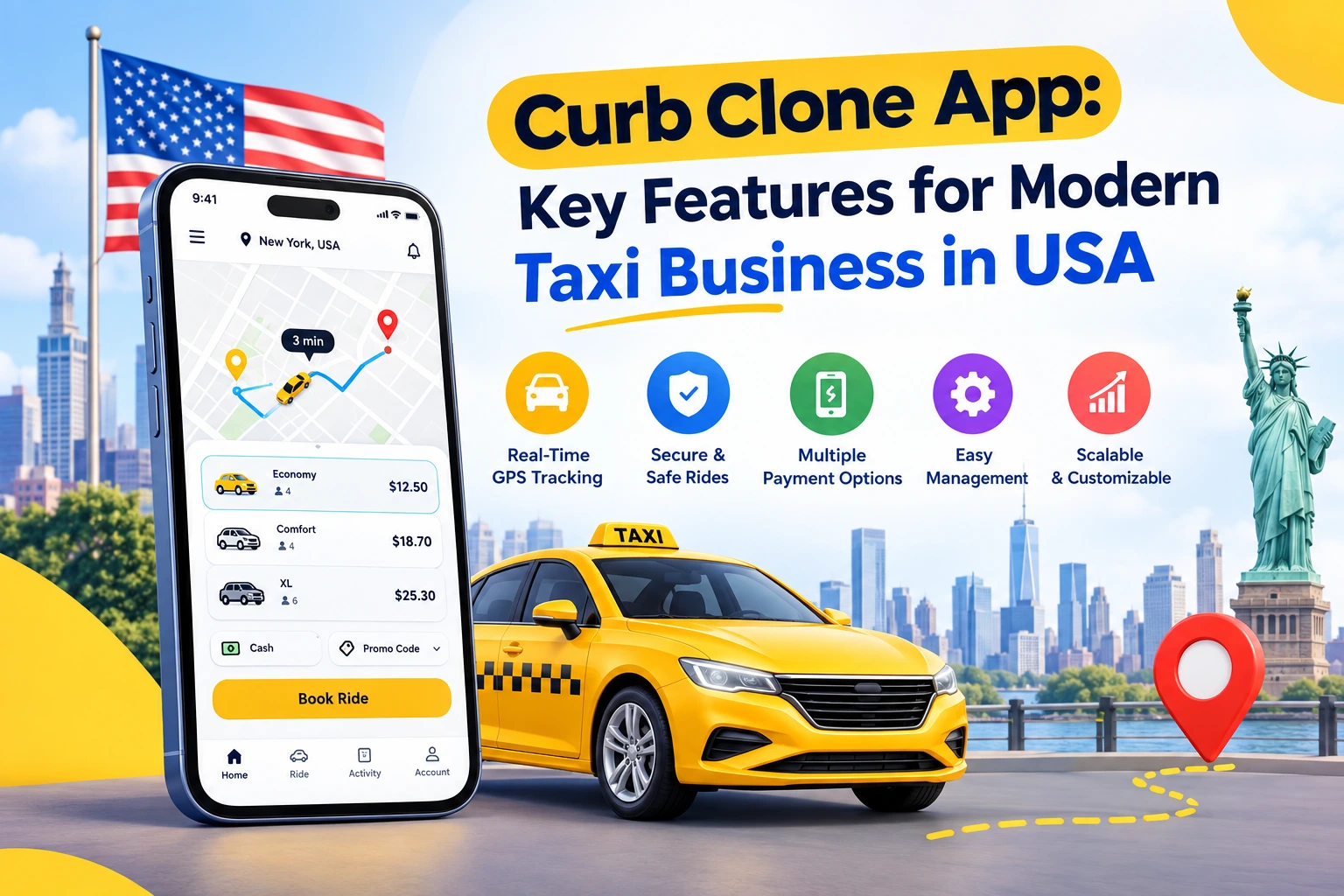
The Curb Clone app model provides a strong foundation for all taxi businesses willing to build a modern digital transport service in the United States of America. Curb creates an integrated ecosystem, including taxi booking, dispatch, payments, fleet technology, corporate transport, and driver technology, all in one system.
Its current platform supports on-demand and advance bookings, upfront pricing in selected markets, business profiles, street-hail payment, and fleet management.
A Curb-inspired platform can bring similar capabilities to an independent taxi business while adding customized services, branding, pricing, and technology.
Understanding the Curb Business Model
A Curb Clone is not simply a copy of a taxi booking application. The idea is to recreate the broader operating model behind a digitally managed taxi network.
Curb's current ecosystem includes rider booking, business transportation, fleet systems, digital meters, payment technology, dispatch management, and driver tools.
This combination is suitable for the USA taxi market, in which traditional street-hail services coexist with pre-booked rides, niche business accounts, fleet operations, and digital booking.
So, modern Curb-style systems can connect riders, drivers, fleet operators, dispatchers, and business partners, instead of using taxis as a function of just booking via a mobile app.
Multiple Ways to Book a Taxi
One of the important lessons from the Curb model is that taxi customers should not be limited to a single mobile application.
Curb is currently accessible through a number of different booking channels, including its mobile app, Concierge web platform, call center, API integrations, QR Booker, Taxi Button, and Pair & Pay.
A modern taxi booking app development project can therefore include:
- Mobile app bookings
- Web bookings
- Scheduled rides
- Call-center bookings
- QR-based booking
- Corporate bookings
- Manual dispatcher bookings
- API-based third-party bookings
This approach is particularly useful in the US market, where taxi businesses may serve consumers, hotels, hospitals, airports, companies, and government organizations.
Upfront Pricing and Flexible Fare Management
Fare transparency is increasingly important in digital transportation.
The Curb platform implements upfront pricing in select locations that enables riders to know the total trip cost before booking. An example of this is Curb's system, which leverages both current and previous trip information, metered fare rates, current traffic, and waiting times to establish upfront pricing.
A customized platform can provide similar fare visibility while allowing the taxi company to control its own pricing structure.
Fare rules can be configured around distance, time, vehicle category, waiting time, airport routes, special events, or peak demand. Advanced systems can also use AI to analyze traffic, demand, and other real-time conditions when generating fares.
This gives a taxi business greater control over how pricing works in different operating situations.
Digital Meter and Fare Management
Taxi businesses operate differently from many purely app-based ride-hailing platforms because metered transportation remains important in regulated markets.
Curb provides digital meter solutions designed around taxi fleet operations, including NTEP-certified technology and smartphone-based driver solutions.
A Curb Clone app development project can incorporate digital fare management so that the platform can support:
Trip begins → Meter/fare calculation → Distance and time tracking → Final fare → Payment → Receipt
This also establishes a more definite link between the trip taken by the driver, the payment made by the rider, and the financial records held by the company.
Strong Taxi Dispatch Software Is Essential
A modern taxi operation needs more than an app. It needs effective taxi dispatch software behind the scenes.
The technology of dispatching has an impact on the way bookings are distributed, the method of keeping track of drivers, and the performance of scheduled trips.
The dispatching ecosystem of Curb includes cloud-based management, dispatching, billing, routing, and fleet management. Its Way2Cloud platform supports on-demand and advance-booked trips and provides tools for managing driver performance.
A Curb-inspired system can provide similar controls while allowing the taxi company to define its own dispatch rules.
For example, bookings can be assigned according to driver proximity, availability, vehicle type, scheduled-trip requirements, or specific fleet rules. Rider & driver management is controlled by the admin panel.
Support Phone and Manual Bookings
Not every passenger will book through a mobile application.
This is especially important for established taxi businesses that already receive bookings through phone calls, hotels, businesses, or dispatch centers.
Curb's business platform provides several booking channels, including the mobile app, Concierge web booking, call-center booking, APIs, QR booking, and other request methods.
A modern taxi business app can follow the same multi-channel model.
An administrator or dispatcher can create a booking manually when a customer calls. Hotel staff can request transportation for guests, while corporate administrators can schedule rides for employees.
This allows digital and traditional taxi operations to work together rather than forcing every customer into one booking channel.
Concierge Booking for Hotels, Hospitals and Businesses
Not every passenger will make a booking personally.
Hotels might have to arrange rides for their patrons. Hospitals might require vehicles that transport patients. Companies might be tasked with providing transportation services for their staff members and visitors.
Curb Concierge has been created especially for this kind of operations, allowing administrators to schedule several rides at once, control guest data, and provide ride updates.
A taxi booking app solution can replicate this concept through a dedicated web-based concierge panel where authorized staff can:
1. Enter passenger details.
2. Select pickup and destination.
3. Schedule an immediate or future trip.
4. Assign or dispatch a vehicle.
5. Monitor the trip.
6. Access the final trip record and payment details.
This feature can create an additional business channel beyond ordinary consumer bookings.
Fleet Management Should Be Part of the Platform
A growing taxi business may manage dozens or hundreds of vehicles. At that stage, basic driver management is no longer enough.
Fleet operators find it necessary to view the availability of their vehicles, driver activity, trip performance, maintenance information, earnings, and service coverage.
Curb offers fleet technology that includes driver management, dispatching, digital meters, payment technology, routing technologies, and other operational systems.
A strong taxi app development strategy should therefore include fleet management from the beginning, even if the initial fleet is relatively small.
What V3Cube Offers Beyond a Basic Market Solution
V3Cube taxi platform is more than a simple clone with just rider and driver apps. Its unique solution features a rider booking system, driver management functions, fleet operations, dispatcher functionality, and accounting tools.
A notable point is that V3Cube's taxi platform technology combines artificial intelligence with operational automation. The platform supports AI fare calculations, modern surge pricing, fraud detection, automatic payment reports for drivers, optimized routes, and driver support based on demand.
Another differentiator is booking accessibility. V3Cube supports WhatsApp taxi booking, manual dispatch, web booking, and mobile applications. Its platform also promotes hotel kiosk booking and multiple administrative panels.
Curb Clone vs a Basic Taxi App
The primary distinction is in the extent of the technology.
A simple taxi application usually concerns only the customer reservation, driver acceptance, GPS tracking, and payments. In contrast, a platform like Curb is more advanced since it combines digital reservation with dispatch services, fleet management, meter-based fare, corporate transport, and regular taxi operation
This broader approach is particularly useful for US taxi companies that need to support both app-based and conventional transportation.
A business can therefore use the platform as a complete operating system rather than treating the application as a separate sales channel.
Building a Modern On-Demand Taxi App
An on-demand taxi app should be designed around operational reliability.
A taxi application requires real-time GPS, quick matching with drivers, safe payment services, reasonable fare charges, notifications to riders, customer support, and strong admin controls.
The application should be tested for both expected and unexpected scenarios, such as cancellation by a driver, failure in making payments, booking a trip in advance, peak time service challenges, service not reaching some locations, or loss of internet connectivity.
The app should be scalable in terms of accommodating more vehicles, drivers, customers, and locations as it grows.
Final Thoughts
Today's Curb Clone app cannot be seen merely as a taxi-booking service. The Curb model showcases how rider bookings, digital payments, fleet management, dispatch services, driver technologies, corporate transportation, and traditional taxi businesses can integrate.
For a US taxi business, this broader structure can create a stronger digital foundation. Capabilities like upfront pricing, digital meters, corporate accounts, a variety of booking channels, special transport, AI pricing, fraud protection, and automated reimbursement can help the platform to keep up with modern transport needs.
With the right ride-hailing app development strategy, a Curb-inspired platform can support both established taxi fleets and new transportation businesses while leaving room for future services and technology.
FAQs
Q1. Can AI be added to a taxi booking app solution?
Yes. The applications of AI technology extend to dynamic pricing, route optimization, predicting demand, fraud prevention, matching drivers to riders, and generating automatic reports, among various other functions.
Q2. What features are important in Curb Clone App Development?
Key features include ride bookings, tracking rides in real time, matching drivers and riders, payments through online platforms, fare estimation, scheduled rides, fleet management, and reporting.
Q3. Can a Curb Clone support traditional taxi bookings?
Yes. The platform is also capable of processing bookings made via an app alongside Phone-based dispatch, conventional bookings, and corporate reservations.
Q4. Why is taxi dispatch software important?
Taxi dispatch software is aimed at helping operators make ride assignments, keep track of drivers, schedule rides, manage fleet operations, and monitor other key processes from a single software solution.